
The best questions to ask on the first date!
The first date… Often a disaster, rarely a success. We wish we had taken some dating lessons or private lessons, because we want to succeed on our dates […]
 Download the app
Why do some people seem ready for sex out of nowhere, while others can go all day without thinking about it… and then suddenly get in the mood once kissing starts?
If you’ve ever wondered whether your sexual desire is “normal,” here’s the reassuring answer: there isn’t one single way desire is supposed to work.
Some people experience desire spontaneously. Others need the right context before desire appears. For many of us, it changes depending on the day, the relationship, stress levels, sleep, hormones, mood and about a hundred other things.
Understanding the different types of sexual desire can make your own reactions feel much less mysterious and it can be particularly useful when you and your partner don’t seem to get in the mood in exactly the same way.
So, which one sounds most like you?
We tend to imagine sexual desire as a very simple sequence:
You feel horny → you initiate something → you get aroused → you have sex.
And yes, sometimes it works exactly like that.
But human sexuality can be much less linear.
Research into sexual response has shown that desire doesn’t always need to come first. Sometimes affection, flirting, touching or another enjoyable stimulus comes first and desire develops afterwards.
In other words, not thinking about sex five minutes ago doesn’t necessarily mean you won’t want it five minutes from now.
That brings us to the two best-known patterns.
Spontaneous sexual desire is probably the version we see most often in movies.
Nothing in particular needs to happen first. You simply become aware that you want something sexual.
Maybe your partner walks past you and suddenly looks ridiculously attractive.
Maybe a thought pops into your head in the middle of the afternoon.
Maybe you wake up already in the mood.
There’s an internal feeling of:
“Yep. Sex sounds great right now.”
You might recognize yourself here if:
Spontaneous desire isn’t better, stronger or more “sexual” than other forms of desire.
It simply means that desire often arrives before stimulation.
Responsive desire works almost in the opposite direction.
Instead of feeling desire and then becoming intimate, you may enter an affectionate or sensual situation first and desire gradually follows.
You might begin with:
“I’d love to cuddle.”
Then kissing feels good.
Then touching feels good.
And somewhere along the way your brain goes:
“Actually… yes. I’m very into this.”
Researcher Rosemary Basson helped bring much more attention to this pattern of sexual response, particularly in the context of long-term relationships. Her work challenged the idea that spontaneous desire always has to be the starting point of a satisfying sexual experience.
This might sound familiar if:
And this is important:
Responsive desire does not mean forcing yourself to have sex when you don’t want to.
There’s a big difference between:
“I don’t want this.”
and:
“I’m not horny yet, but cuddling and seeing where it goes sounds nice.”
At any point, you can still decide that you’re not feeling it.
Maybe neither of those descriptions feels quite right.
Your answer might simply be:
It depends. A lot.
Welcome to being human.
For some people, sexual desire is incredibly sensitive to context.
On holiday, with no alarm clock and nowhere to be? Suddenly your libido is thriving.
Wednesday night after eight hours of work, grocery shopping, three unread emails from your landlord and five hours of sleep?
Not so much.
This isn’t a separate medical category of desire, but it’s a very useful way to understand how sexuality works in everyday life.
One influential model of sexual response suggests that our reactions involve both sexual excitation and sexual inhibition.
Think of them like an accelerator and a brake.
Things that may press your accelerator could include:
Your brakes might respond to:
Both systems are normal. People just differ in how sensitive each one is.
Sometimes improving your sex life isn’t about finding more things that turn you on.
It’s about noticing what keeps hitting the brakes.
Some people naturally experience sexual desire less frequently than others.
That doesn’t automatically mean something is wrong.
Maybe sex is enjoyable when it happens, but you rarely think about initiating it.
Maybe other forms of affection feel more important to you.
Maybe your libido has simply never been particularly loud.
There is no universal number of times you’re supposed to want sex per week, month or year.
What matters much more is how you feel about your own level of desire.
If you’re perfectly happy with it, a lower level of sexual interest does not need to become a problem simply because someone else has more.
It becomes worth exploring when the change is unusual for you, causes distress, affects your relationship in a way that bothers you, or comes alongside things such as pain or other symptoms.
For many people, sexual desire isn’t especially high or low.
It moves.
Sometimes a lot.
You might go through a period where sex seems to be constantly on your mind, followed by several weeks where it barely crosses it.
That can happen because sexual desire lives inside a much bigger system.
Sleep matters.
Stress matters.
Your emotional state matters.
Your relationship matters.
Health can matter.
Certain medications can matter.
Major changes in life can matter.
So if your libido isn’t perfectly consistent, you’re in very good company.
Rather than asking:
“Why isn’t my sex drive always the same?”
a more useful question may be:
“What seems to help my desire show up and what tends to make it disappear?”
Probably more than one.
You might mostly experience responsive desire but occasionally get hit with spontaneous desire.
You might normally have a fairly high libido but completely lose interest when you’re stressed.
You might need emotional connection in one situation and novelty in another.
Sexual desire isn’t a personality test result.
It’s more useful to think of these types of sexual desire as patterns that help you understand yourself.
And those patterns can change.
This is where things get particularly interesting.
Imagine one partner tends to experience spontaneous desire.
They think:
“I want sex, so I’ll initiate.”
Their partner tends to experience responsive desire.
They think:
“I’m rarely randomly horny, but once we start connecting, I often get into it.”
Neither person is doing anything wrong.
But without understanding the difference, both can misread the situation.
The spontaneous partner might think:
“Why don’t they ever want me first?”
While the responsive partner may think:
“Why am I expected to already be horny before anything has even happened?”
Knowing how each person experiences desire can remove a surprising amount of pressure.
Instead of asking only:
“Are you horny?”
you can sometimes ask:
“Would some closeness feel good right now?”
Those are not always the same question.
If you want to understand your own desire better, try these:
You don’t need perfect answers.
Simply noticing your patterns can already make sex easier to talk about.
This can also be a surprisingly fun conversation to have with your partner.
You could each separately answer:
What are three things that reliably put me in the mood?
Then try guessing each other’s answers.
You may know one immediately.
Another might completely surprise you.
And if talking about sex face-to-face sometimes feels a little too much like scheduling a performance review, you can make things more playful.
Couple Game uses questions and challenges with several levels of intensity, so you can start light and gradually move toward more intimate territory. Sometimes reacting to a question or challenge is much easier than beginning with: “So, let’s discuss our sexual desire.”
👉 Download Couple Game on the App Store
👉 Install Couple Game on Android with the official APK
The goal isn’t to put either of you in a box.
It’s to get curious about how you each work.
One of the easiest traps is comparing your desire to someone else’s.
Your partner.
Your friends.
Characters in movies.
Whatever people claim their sex life looks like online.
But sexual desire isn’t a score.
Having spontaneous desire doesn’t make you more passionate. Having responsive desire doesn’t mean your attraction is weaker. Having less frequent desire doesn’t automatically mean something is wrong with you or your relationship.
What matters is whether your sexuality feels comfortable, consensual and satisfying for you.
And if something has changed dramatically, is causing distress, or involves pain or other physical symptoms, that’s a good reason to talk with a qualified healthcare professional rather than simply blaming your libido.
For everyone else?
Learning how your desire works can be much more useful than wondering whether you have the “right” amount of it.
Because when it comes to sex, understanding what presses your accelerator, and what gently releases the brakes, can make a surprisingly big difference.


The first date… Often a disaster, rarely a success. We wish we had taken some dating lessons or private lessons, because we want to succeed on our dates […]

Instead of searching for 30 minutes for the next show you’re going to watch on Netflix, how about you and your partner play a little game? Even if […]
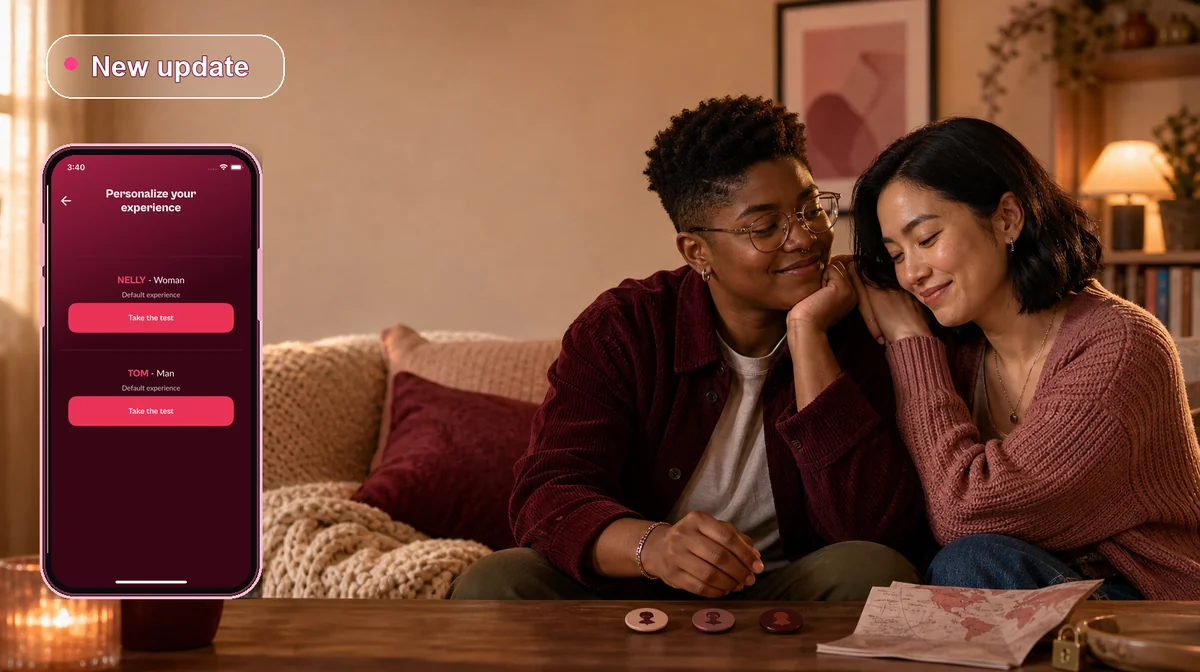
Hundreds of thousands of you have taken time to play our game for couples. Because we want you have the best experience ever, we are happy to announce […]