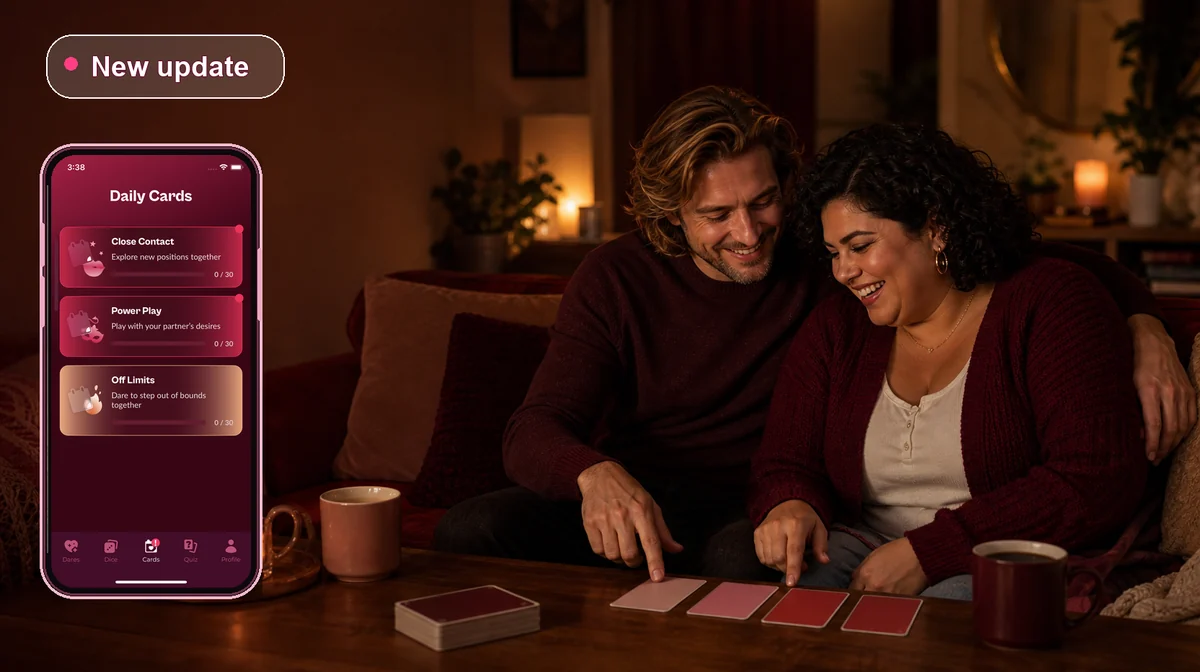
Discover the new update of our game for couples app!
Did you know? A team of 15 people is working tirelessly to offer you a unique experience as a couple. Indeed, thousands of people are having a great […]
 Download the app
Maybe you’ve walked past a sex shop together and joked about going inside. Maybe one of you already owns a toy but has never quite known how to bring it into your relationship. Or maybe the subject appeared casually one evening and was immediately followed by, “Wait… are you serious?”
Introducing a sex toy into a relationship can feel surprisingly loaded for something that is ultimately meant to make intimacy more fun. It can bring up curiosity and excitement, but also insecurity: Am I not enough? Is there something they want that I can’t give them? What if I don’t like it? What if using one together feels awkward?
Those reactions don’t mean toys are a bad idea for your relationship. They usually mean you’re trying something new, and new things tend to feel much easier when nobody is expected to know exactly what they’re doing from the beginning.
If you’re thinking about introducing sex toys safely, the best place to start isn’t actually with the toy. It’s with the conversation around it.
There’s a big difference between saying “I think we need a toy” and “I saw something that looked fun and wondered what you’d think about trying it together.”
The first can accidentally sound like a review of your current sex life. The second creates curiosity without suggesting that anything is missing. That distinction is particularly useful if toys have never been part of your relationship before, because a partner may initially hear “I want to try a vibrator” as “what we do now isn’t satisfying me.”
Choose a relaxed moment when you’re not already having sex and neither of you feels under pressure to make an immediate decision. You might mention something you’ve read about, ask whether your partner has ever been curious about toys or simply browse some options together. If talking openly about sexual preferences is still relatively new for you, our guide on how to talk about sex with your partner without feeling awkward can make that first conversation feel much less intimidating.
Most importantly, leave room for your partner not to know how they feel yet. Curiosity doesn’t have to turn immediately into a purchase, and agreeing to look at toys together isn’t the same thing as agreeing to use one.
One of the most common insecurities around toys is the idea of competition. If a device can create a sensation that a hand, mouth or body can’t reproduce in exactly the same way, where does that leave the partner?
Still very much in the relationship.
A sex toy is a tool, not another participant. The interesting part of using one together is often not simply what the object does, but what the two of you do with it: choosing it, deciding how to use it, paying attention to each other’s reactions and discovering something new together.
That mindset can take a lot of pressure out of the experience. Nobody needs to compete with a motor, just as nobody needs to compete with a massage oil because it makes a massage feel different. The toy simply gives you another sensation to explore.
It can also be helpful to avoid presenting toys exclusively as solutions to problems. They can certainly be useful when somebody wants a particular kind of stimulation, but couples with satisfying sex lives use them too. Novelty, curiosity and play are perfectly good reasons to try something new.
Buying a first toy as a surprise can sound exciting, but choosing one together is usually a much better introduction. It gives both partners an opportunity to say what looks interesting, what feels intimidating and what they definitely don’t want.
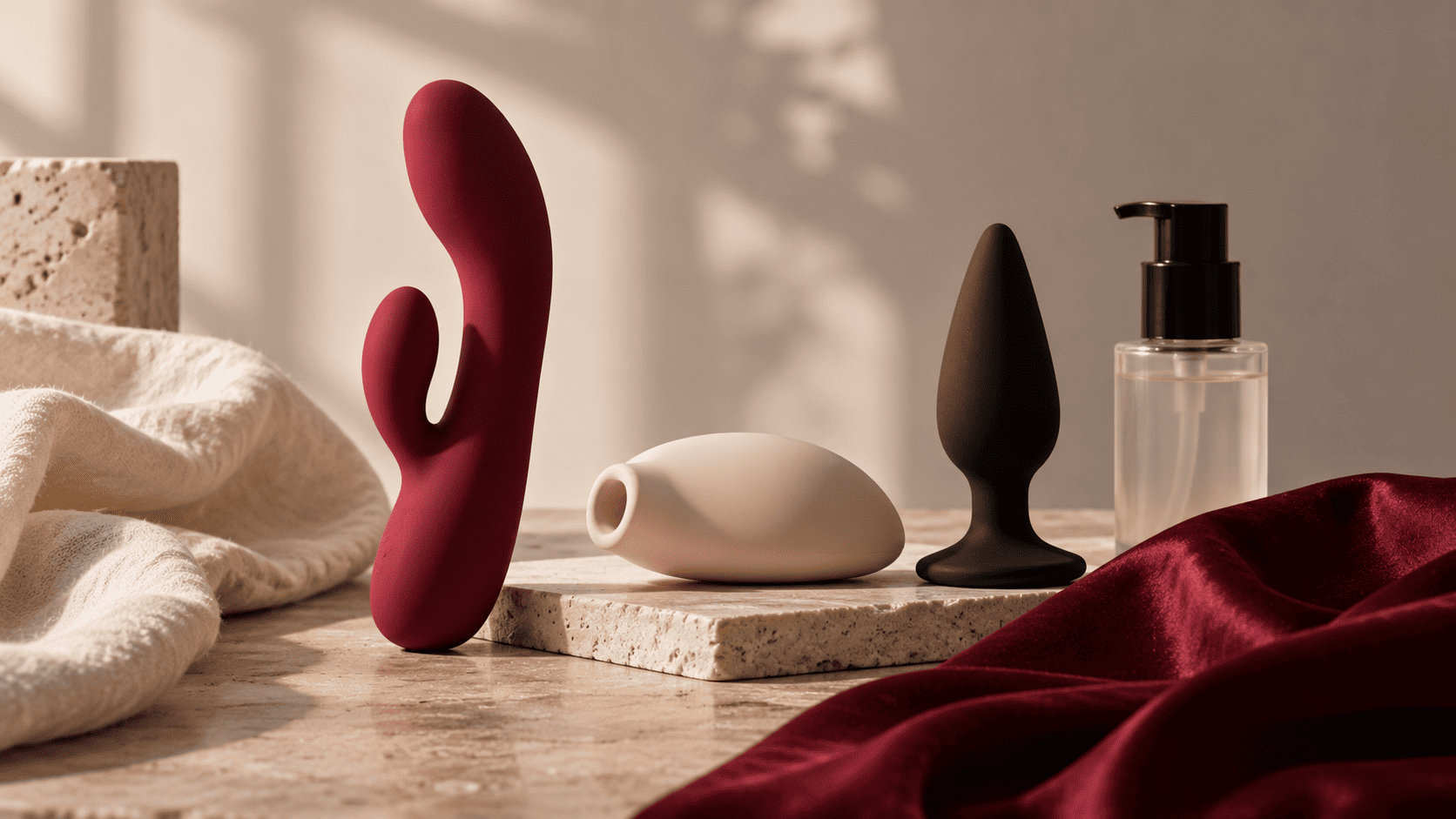
You don’t need to begin with the most elaborate product you can find. In fact, something simple and easy to control is often more comfortable when you’re still discovering how toys fit into your dynamic. A small external vibrator, for example, can be incorporated gradually without changing everything else you already enjoy.
Look for products from reputable manufacturers and retailers that clearly identify what the toy is made from and provide instructions for use and cleaning. Non-porous materials such as medical-grade silicone, stainless steel or borosilicate glass are generally easier to clean than porous materials. If you’re unsure what a particular product contains or the manufacturer provides very little information about it, choosing something else is a sensible option.
For anything designed for anal use, the shape matters as well: it should have a flared base or another design feature that prevents the toy from slipping completely inside the body. This is one of those details that isn’t particularly glamorous, but definitely matters more than the packaging.
Lubricant can make using many toys more comfortable, but not every lubricant is suitable for every material. Water-based lubricants are generally a versatile option and are compatible with most toys and condoms. Silicone-based lubricants last longer, but they may not be suitable for some silicone toys, so it’s worth checking the manufacturer’s instructions before combining them.
This is also a good moment to remember that discomfort isn’t something you need to push through to make the experiment successful. If something feels unpleasant, add more lubricant, change what you’re doing or stop completely. A first experience with a toy doesn’t need to culminate in anything in particular.
That principle applies beyond toys too. Exploring sexually should feel like discovering what you enjoy rather than proving how adventurous you can be. If novelty is something you both like, our guide to erotic languages can help you understand whether experimentation, anticipation, sensory experiences or something else tends to create excitement for each of you.
There’s no rule saying that once the package is open, the toy has to become the main event.
Take it out. Look at it together. Figure out the controls. Try it against a hand, arm or thigh first so you both know what the different settings feel like. If it vibrates, start lower than you think you need and work upwards rather than beginning at maximum intensity.
This slower introduction can make the experience feel much more playful, particularly if one person is slightly nervous. It also removes the awkward moment of trying to understand three buttons while simultaneously attempting to appear effortlessly seductive.
You might even decide not to use it sexually that evening. That’s fine. Familiarity itself can make the next attempt feel much more natural.
When you use a toy together for the first time, it can be tempting for the person holding it to become very enthusiastic about experimenting. But stronger, faster and more intense aren’t automatically better.
Start gently and let the person experiencing the sensation guide what happens next. They can move the toy themselves at first, place a hand over their partner’s or simply say what feels good. The more easily you can communicate during the experience, the less anyone has to guess.
And communication doesn’t need to sound clinical. “A little slower,” “stay there,” “softer” and “I like that” are all useful information. So is “I’m not into this.”
If you’re already comfortable turning sexual discovery into something playful, you can use that same curiosity elsewhere too. Our guide to 20 tips and erotic games to spice up your sex life has more ideas for experimenting together without making novelty feel like a performance.
Different toys require different care, so the manufacturer’s cleaning instructions should always be your starting point. Whether a toy can be submerged, washed with soap and water or cleaned another way depends on its material, construction and whether it is waterproof.
Cleaning matters especially when toys are shared between partners or used on different areas of the body. Wash them according to their instructions before and after use, and avoid moving a toy from anal use to vaginal use without thoroughly cleaning it first or changing the barrier covering it. Condoms can also be used over compatible toys and replaced between partners or body areas when appropriate.
Storage matters too. Once a toy is completely clean and dry, keep it somewhere protected from dust and contamination. Some materials can also react when stored directly against one another, so individual storage bags or the original packaging can be useful when the manufacturer recommends them.
None of this needs to turn your bedroom into a laboratory. It’s simply the less exciting part of owning something that comes into contact with sensitive areas of the body, rather like washing anything else designed for intimate use.
You turn it on and can’t work out how to turn it off. It makes considerably more noise than expected. Someone presses the wrong button. The toy rolls off the bed at the least cinematic moment imaginable.
Welcome to trying something new together.
It’s easy to imagine introducing a toy as a perfectly choreographed scene, especially when advertising tends to present every intimate product as though everyone instantly knows what to do with it. Real couples are much more likely to laugh, adjust, stop, try something else and gradually figure out what works.
That doesn’t ruin the mood. Being able to laugh together can actually make experimentation much easier because neither person has to perform expertise they don’t have.
And if you discover that the toy itself isn’t for you, that’s useful information too. You haven’t failed at sex toys. You tried one thing and learned something about yourselves.
Sexual compatibility doesn’t mean enjoying every sensation equally. One partner may absolutely love a particular toy while the other feels relatively indifferent to it. You might enjoy using it on your partner without particularly wanting it used on you, or discover that it works brilliantly alone but doesn’t add much when you’re together.
All of those possibilities are normal.
Instead of asking whether you are now officially “a couple who uses toys,” ask a simpler question: does this particular thing add something enjoyable to your sex life? If yes, keep it. If not, it doesn’t need to become part of your routine just because you bought it.
The same approach applies to sexual preferences more generally. Compatibility is less about matching every desire than creating enough shared space for both partners to feel satisfied and respected. Our sexual compatibility guide explores that idea in more detail.
Once you get past the initial “Should we buy one?” conversation, toys can become surprisingly useful conversation starters. Browsing together naturally leads to questions about sensations, fantasies and preferences that might otherwise never come up.
Would you like something gentle or intense? Do you like the idea of giving your partner control? Is there something you’d be curious to try but wouldn’t want to own? Would using a toy feel exciting, funny, intimidating or all three?
You don’t need to purchase everything you discuss. Sometimes browsing is simply another way of discovering how your partner thinks about pleasure.
This is also why games can work well for couples who find direct sexual conversations a little formal. Couple Game uses questions and challenges to create those openings naturally, with different levels of intensity depending on what you both feel comfortable exploring. You might start the evening talking about preferences and end up discovering an idea neither of you had thought to suggest.
Download Couple Game:
Bringing a toy into your relationship doesn’t have to transform your sex life. It doesn’t need to become a regular feature, lead to more adventurous toys or unlock a completely different version of you as a couple.
Maybe you’ll love it and wonder why you waited so long. Maybe one of you will enjoy it more than the other. Maybe you’ll use it occasionally. Maybe you’ll try it twice and then rediscover it in a drawer six months later.
The useful part is creating a relationship where either of you can say, “I’m curious about this,” without that curiosity becoming a demand.
Choose together. Read the instructions. Start gently. Communicate while you experiment. Keep your toys clean and use products that are appropriate for their materials. And if either of you wants to stop, stop.
There’s no correct level of adventurousness to reach.
The goal is simply to find more things you genuinely enjoy together.


Did you know? A team of 15 people is working tirelessly to offer you a unique experience as a couple. Indeed, thousands of people are having a great […]

With life’s daily stress, work, and routines, passion can sometimes take a backseat in a relationship. The good news? Rediscovering intimacy is entirely possible. Through open communication, meaningful […]

Maybe you love the idea of roleplay. Maybe the thought of looking your partner in the eye and saying, “Tonight, I’m someone else,” makes you want to disappear […]
