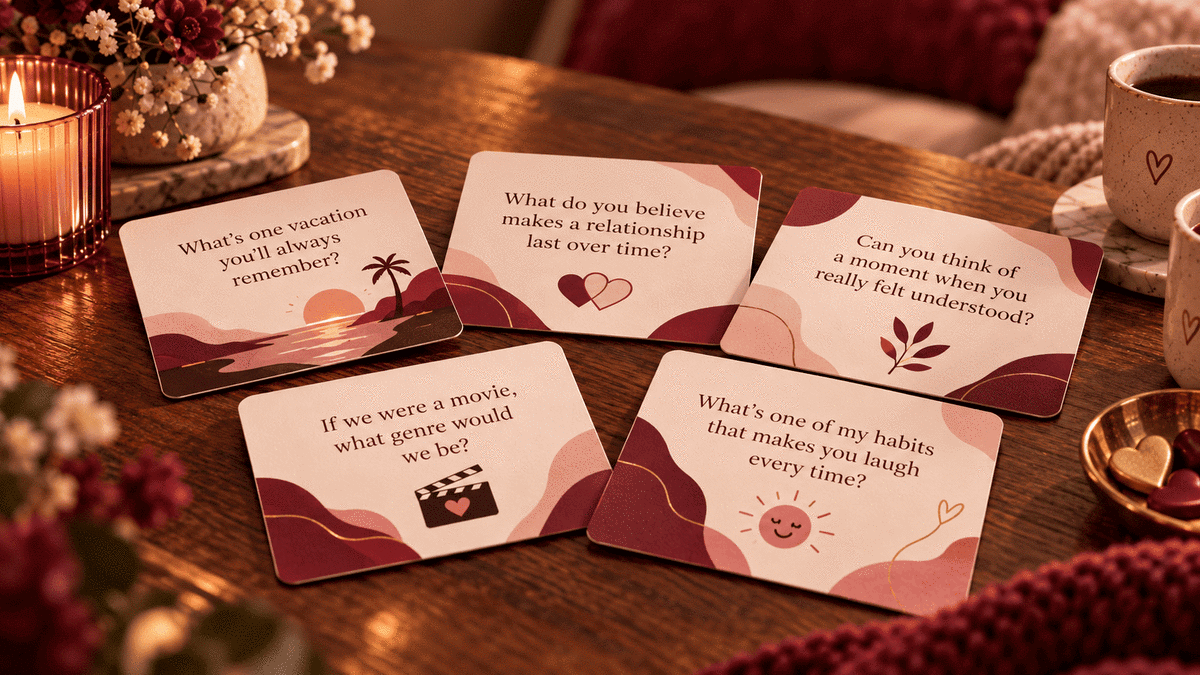
15 Get to Know You Questions for Couples: Deepen Your Bond
Why asking these questions can shift your connection ? 🔗 Want tips for get to know you questions for couples ? Even if you’ve been together for a […]
 Download the app

There are things you can tell your partner without thinking twice. What happened at work. What you want for dinner. The weird dream you had last night.
Then there are sexual fantasies.
Suddenly, telling the person who knows almost everything about you that something specific turns you on can feel strangely terrifying. What if they think it’s weird? What if they assume you secretly want to do it? What if the fantasy involves something, or someone, that makes them insecure? What if they simply look at you and say, “Wait… what?”
For many couples, discussing sexual fantasies feels vulnerable precisely because fantasies are private. They can be surprising, contradictory and sometimes completely disconnected from what we would actually want to experience in real life.
Talking about them doesn’t have to mean handing your partner unrestricted access to everything you’ve ever imagined. And sharing a fantasy certainly doesn’t mean asking to make it happen. It can simply be another way of understanding each other, one that becomes much easier when curiosity matters more than judgment.
This is probably the most useful thing to establish before you start comparing fantasies: imagination and intention are not the same thing.
You can find a scenario exciting in your head and have absolutely no desire to experience it in reality. The fantasy might work precisely because it is imaginary, completely controlled and free from the practical or emotional consequences it would have outside your mind.
That distinction becomes especially important with fantasies involving other people, unfamiliar dynamics, roleplay or situations that would make you uncomfortable in real life. Hearing one of these from your partner can trigger an immediate question: Does this mean they actually want that?
Sometimes they might. Often, they don’t.
Instead of jumping straight from “this turns me on” to “so you want us to do this,” stay with the fantasy for a moment. Ask what part of it is exciting. It might be the feeling of being pursued, the novelty, the confidence, the loss of control, the attention or simply the fact that the scenario feels completely unlike everyday life.
Understanding the feeling underneath a fantasy can tell you much more about your partner than taking every detail literally.
People don’t need their partner to judge them to feel ashamed of a fantasy. We’re often perfectly capable of doing that ourselves.
Maybe the fantasy doesn’t fit the person you think you’re supposed to be. Perhaps it feels too adventurous, too romantic, too dominant, too submissive or simply too strange to say out loud. Sometimes the embarrassment comes from having no idea whether what you imagine is “normal.”
But fantasies don’t need to pass a personality test.
What turns you on in your imagination doesn’t automatically define your values, your relationship or the way you behave outside that fantasy. Human sexuality is full of associations, stories and ideas that don’t always fit neatly into our everyday identity.
That doesn’t mean every fantasy needs to be shared. Privacy is allowed too. But if the only reason you’re hiding something you genuinely want to discuss is that you’re afraid of sounding unusual, it may help to remember that your partner isn’t receiving a final statement about who you are. They’re learning one small part of your inner world.
Nothing creates a relaxed atmosphere quite like making your partner believe they’re about to receive devastating news.
If you want to talk about fantasies, the way you introduce the subject can make a huge difference. Rather than announcing a serious conversation, bring it up during a relaxed moment when neither of you is expected to act on anything immediately.
You could ask whether your partner ever fantasizes about things they wouldn’t necessarily want to do in real life. Mention something you’ve read or seen that made you curious. Or start with a fantasy that feels relatively easy to share before moving into more vulnerable territory.
The conversation also doesn’t have to happen in bed. In fact, talking during a walk, on the sofa or over a drink can remove the assumption that whatever you mention is supposed to happen five minutes later.
If sexual conversations in general still feel difficult between you, our guide on how to talk about sex with your partner without feeling awkward is a useful place to start before getting into fantasies specifically.
You decide how much of a fantasy you want to share.
Sometimes describing the entire scenario feels exciting. Sometimes it feels far too exposing. You can begin with the part that actually matters to you.
Maybe you don’t want to recount an elaborate fantasy, but you can say that the idea of being seduced by your partner as though you were strangers turns you on. Maybe you’re curious about giving up some control. Perhaps you like imagining a situation where you feel particularly confident, desired or adventurous.
This can make the conversation much easier because you’re talking about what excites you without feeling obligated to narrate every scene your imagination has ever produced.
It also gives your partner room to connect with the underlying idea. They might not share your exact fantasy but discover that the part you love ; anticipation, mystery, being pursued, taking control ; appeals to them too.
If you’re curious about those underlying patterns, our article on erotic languages explores how different people can be drawn to very different routes into desire.
Being told a fantasy can catch you off guard.
Maybe you expected your partner to say “sex on vacation” and instead received something significantly more specific. You don’t have to instantly know how you feel about it.
If your first reaction is surprise, give yourself a moment before turning that surprise into judgment. Asking “What do you like about that idea?” is usually much more useful than “Why would you want that?”
Tone matters enormously here. The person sharing something vulnerable is likely paying attention to every facial expression, pause and change in your voice. You don’t need to pretend you love an idea you don’t like, but you can be kind while being honest.
Something as simple as “I don’t think I’d want to do that, but I’m glad you felt comfortable telling me” keeps the conversation open without creating false enthusiasm.
And if you genuinely don’t know what you think yet, say that. “I’ve never thought about that before, let me sit with it” is a perfectly reasonable answer.
This deserves to be explicit.
Talking about a fantasy does not automatically mean wanting to recreate it. Being curious about an idea doesn’t mean agreeing to try it. And saying you might be interested in exploring something doesn’t remove your ability to change your mind later.
If a fantasy does sound exciting to both of you, treat the conversation about actually trying it as a separate step. What version would feel comfortable? What parts appeal to you? What parts don’t? Are there boundaries you want to establish first?
Sometimes you can also explore the idea of a fantasy without reproducing it literally. If the appeal is feeling like strangers, you might dress up and meet at a bar. If it’s about confidence or becoming someone different for an evening, a playful character may be enough. Our roleplay scenarios for couples offer several ways to play with fantasy while keeping the scenario completely within boundaries you both choose.
And sometimes the fantasy stays exactly where it began: in your imagination.
That’s allowed too.
This can be one of the trickiest conversations because it’s easy for imagination to collide with insecurity.
A fantasy involving another person doesn’t necessarily mean your partner wants to replace you, cheat on you or change the boundaries of your relationship. Just as fantasizing about being somewhere else doesn’t mean you hate your home, sexual imagination can contain scenarios that aren’t plans.
Still, knowing that intellectually doesn’t mean you won’t have an emotional reaction.
If something your partner shares makes you insecure, you can say so without turning the fantasy into an accusation. “I know you’re telling me this as a fantasy, but I noticed it brought up some insecurity for me” gives you both something real to talk about.
The person who shared the fantasy can help too. Reassurance doesn’t require apologizing for having an imagination. It can simply mean reminding your partner what is fantasy, what is reality and what you value about the relationship you actually have together.
The aim isn’t to become so relaxed that nothing ever bothers you. It’s to make enough room for honesty that discomfort can be discussed rather than immediately becoming conflict.
Imagine you share something that has lived in your head for years and your partner responds, kindly but unmistakably, “That really doesn’t do anything for me.”
A little anticlimactic? Perhaps.
A relationship crisis? Not necessarily.
Sexual compatibility doesn’t require two people to have identical fantasies. You can be fascinated by something your partner never thinks about, while they have interests you wouldn’t have discovered on your own. What matters is whether there is enough shared territory for both of you to feel fulfilled and enough respect for the places where you differ.
Sometimes fantasies overlap directly. Sometimes the overlap is hidden underneath them. One person’s fantasy about a spontaneous encounter and another’s interest in roleplay might both come from enjoying unpredictability. A desire to be seduced and a desire to take the lead can fit together rather nicely.
Our sexual compatibility guide looks more broadly at how couples can navigate differences in desire, frequency, preferences and boundaries without treating every mismatch as a problem.
Not every intimate conversation needs to involve sitting opposite each other and maintaining intense eye contact.
You can turn fantasy-sharing into a game. Each of you might write down a few scenarios and try to guess which ones the other finds exciting. You could take turns completing a sentence such as “I’ve always wondered what it would be like to…” or rate ideas as something you’d enjoy imagining, something you might consider trying or something that simply isn’t for you.
The categories matter because they keep fantasy separate from intention. “That sounds hot to imagine” and “I want to do that” are two completely different answers.
You can also use Couple Game to take some of the pressure off coming up with the questions yourselves. Its questions and challenges gradually move into more intimate territory, giving you both something external to react to. Sometimes it’s easier to discover a fantasy because a game has brought up the subject than to suddenly announce one over dinner.
And the most interesting moment often isn’t when your answers match. It’s when your partner says something you weren’t expecting and you get to ask, genuinely, “Really? Tell me more.”
Download Couple Game:
There can be a strange assumption that sexual openness means eventually trying everything you’re curious about.
It doesn’t.
A fantasy can have value simply because imagining it turns you on. Bringing it into reality might make it less exciting, impractical or incompatible with your boundaries as a couple. Some scenarios also involve situations that would be unsafe, unethical or impossible to reproduce consensually in real life.
You don’t need to translate every thought into an experience.
In fact, sharing a fantasy with your partner can sometimes be the experience. Talking about it, imagining it together or borrowing one small element from it may be all you actually want.
That freedom makes these conversations much less intimidating. You’re not creating a sexual to-do list. You’re learning how the other person’s imagination works.
Being open-minded doesn’t mean loving every idea your partner shares. It doesn’t mean never feeling surprised, insecure or uncomfortable. And it definitely doesn’t mean agreeing to something because you’re worried that saying no will make you seem boring.
What matters is creating a relationship where curiosity can exist alongside boundaries.
You should be able to say, “That turns me on,” without automatically making a request. You should also be able to hear your partner say, “That’s not for me,” without experiencing it as rejection of you as a person.
Some fantasies will make you both laugh. Some might lead to a very interesting evening. Others will remain private or stay safely in the imagination. And occasionally your partner will tell you something that makes you realize there is still a lot about this person you haven’t discovered yet.
That’s not a sign that you didn’t know each other well enough.
It’s one of the reasons there can still be things left to discover.


Why asking these questions can shift your connection ? 🔗 Want tips for get to know you questions for couples ? Even if you’ve been together for a […]

Do you also have this friend, very nice, who has tested absolutely all the features of Tinder and who is able to tell you about his different dates […]

Music has a unique ability to transform an ordinary moment into an immersive experience. 🎶 In the spicy BookTok world, it’s common to find playlist recommendations specifically curated […]
