
Clitoris : how to take care of it?
The clitoris, this magical yet still misunderstood organ, deserves all our attention. Here are some reminders and a little guide to better understand and appreciate this king of […]
 Download the app
One of you could happily have sex several times a week. The other rarely thinks about it until something actually gets started. One gets in the mood after a long, relaxed evening together; the other can somehow feel desire at 7:30 a.m. while looking for their keys.
Having different sexual rhythms is incredibly common in relationships. The problem usually isn’t that two partners experience desire differently. It’s what those differences can start to mean when nobody really talks about them.
“I always initiate, so maybe they don’t find me attractive anymore.”
“They want sex more often than I do, so maybe something is wrong with me.”
“They said no tonight. Are we becoming less connected?”
Understanding the different libido types in couples can help take some of that interpretation out of the equation. Instead of asking who has the “normal” sex drive, you can start figuring out how desire actually works for each of you.
We often talk about libido as though everyone has a fixed setting somewhere between “not interested” and “constantly in the mood.”
Real life is much messier.
Someone can have a generally strong sex drive and still lose interest completely during a stressful month. Someone who rarely thinks about sex spontaneously may become very interested once kissing, touching or flirting begins. Another person may feel much more sexual on vacation than they do during an ordinary workweek.
Sleep, stress, physical and mental health, medication, hormones, relationship dynamics and major life changes can all influence sexual desire. That means your libido can change not only from one period of your life to another, but sometimes from one day to the next.
So rather than treating libido as a personality trait, it’s often more helpful to think in terms of patterns.
For some people, sexual desire seems to arrive on its own.
They might look at their partner and suddenly want sex. They may think about it during the day, initiate without needing much build-up or become interested simply because the idea crosses their mind.
This is generally described as spontaneous desire.
If this sounds like you, initiating sex may feel fairly straightforward: you feel desire first, so you act on it.
The tricky part comes when your partner doesn’t work the same way. If they rarely initiate spontaneously, it can be tempting to interpret that as a lack of attraction.
But their desire may simply start somewhere else.
For other people, desire is more often responsive.
They aren’t necessarily sitting on the couch thinking about sex. But a long kiss feels good. Cuddling becomes touching. Flirting creates a different atmosphere. Gradually, desire appears.
In other words, the desire doesn’t always start the experience. Sometimes the enjoyable experience allows desire to develop.
This distinction is particularly useful for couples because responsive desire can easily be misunderstood as “low libido.” A partner may rarely walk into the room already wanting sex while still having a very satisfying sex life once intimacy begins.
There is, of course, an essential distinction between “I don’t want this” and “I’m not turned on right now, but I’d enjoy some closeness and seeing how I feel.” Responsive desire never means pushing through a no or participating in sex you don’t want.
If you want to explore this distinction in more detail, our guide to the different types of sexual desire looks specifically at spontaneous, responsive and context-dependent desire.
Sometimes the most accurate answer to “How high is your libido?” is simply: it depends.
Think about two different evenings.
On the first, you’ve slept well, you have nowhere to be the next morning, you feel good in your body, the apartment is quiet and you’ve spent the evening laughing together.
On the second, you’ve worked late, you’re exhausted, the laundry is sitting in the corner, someone needs to answer an email and you have to get up early.
Same person. Same partner. Potentially very different level of desire.
For people whose libido is particularly sensitive to context, creating more pressure around sex can actually make things harder. Sometimes the useful question isn’t “How can I get more turned on?” but “What makes it difficult for me to get there?”
You can understand spontaneous and responsive desire perfectly and still face another very ordinary difference: one of you wants sex more frequently than the other.
There is no universally correct number.
Having sex three times a week isn’t automatically healthier than having sex three times a month. What matters is whether both partners feel comfortable with the sexual relationship they are creating together.
The difficulty is that mismatched desire can become emotional very quickly.
The partner who wants sex more often may experience repeated rejection and start feeling unwanted. The partner who wants it less often may begin to feel watched, guilty or under pressure. Once that pattern develops, initiation itself can become stressful for both people.
This is why treating the higher-libido partner as “too demanding” or the lower-libido partner as “the problem” rarely helps. You have two experiences that need to coexist, not one person who needs fixing.
This is one of the most important distinctions to make.
How often someone experiences sexual desire and how attracted they are to their partner are not necessarily the same thing.
Your partner can find you incredibly attractive and still be exhausted.
They can love physical intimacy but rarely experience spontaneous desire.
They can want affection without wanting that affection to lead to sex every time.
And they can go through a period of lower sexual interest without their feelings for you disappearing.
This matters because once every “not tonight” becomes interpreted as “I don’t want you,” declining sex becomes emotionally loaded for both partners.
Sometimes a no really can just mean: not tonight.
The easier it becomes to talk about these moments without blame or embarrassment, the less room there is for misunderstandings. If starting that conversation feels harder than it should, our guide on how to talk about sex with your partner without feeling awkward offers a few simple ways to make it feel much more natural.
Instead of focusing only on how often each of you wants sex, talk about how desire tends to start.
Does flirting during the day help? Does one of you need time to mentally switch off from work first? Does affection make intimacy easier, or does cuddling become stressful when it feels as though it always has to lead somewhere?
Even the way someone initiates can matter.
A direct “Want to have sex?” may work perfectly for one person and feel abrupt to another. Someone else may respond much more naturally to kissing, a massage or a playful message earlier in the evening.
Physical affection can also exist without being a promise of sex. If that distinction has become blurry in your relationship, our article on being tactile and affectionate in a relationship explores ways of bringing more everyday touch back into the relationship.
It sounds like the most logical question, but it can be surprisingly limiting.
If one partner experiences mostly spontaneous desire, they may genuinely know immediately whether they want sex.
A responsive partner might not.
So occasionally try replacing:
“Are you horny?”
with something like:
“Would you like to cuddle for a while?”
“Want a massage?”
“Can I kiss you?”
“Do you feel like being close tonight?”
Those questions leave space for intimacy without assuming where it has to end.
And crucially, either person can still stop there. The goal isn’t to disguise an invitation to sex. It’s to recognize that for some people, desire is something they discover along the way rather than something they need to bring with them at the beginning.
Instead of comparing your sex drives, try comparing the conditions that affect them.
Think individually about what tends to make desire easier. Maybe it’s privacy, flirting, novelty, feeling emotionally connected, having plenty of time, dressing up, getting away from home or simply feeling rested.
Then think about what tends to shut desire down. Stress? Feeling rushed? Mess around the house? Body insecurity? An unresolved disagreement? Fear that every affectionate gesture will automatically become sexual?
You may discover that you don’t need to “increase” anyone’s libido at all. You simply need to understand the circumstances in which each person’s desire has room to appear.
This is also where preferences can become much more individual than a simple high-libido/low-libido distinction. Our guide to erotic languages explores some of the different things people find exciting, from sensory experiences and anticipation to more adventurous forms of play.
And if novelty happens to be one of your accelerators, you don’t necessarily need to reinvent your entire sex life. Even a small change can shift the mood. You can explore some ideas in our guide to 20 tips and erotic games to spice up your sex life.
This can become a sensitive issue even when both partners are satisfied with the sex they have.
The person who initiates may eventually wonder, “Would anything ever happen if I stopped?”
Meanwhile, the other person may genuinely enjoy intimacy but simply not experience the internal cue that makes initiating feel obvious.
Talk about it outside the bedroom rather than waiting until someone feels rejected.
The solution doesn’t necessarily have to be “you need to initiate 50% of the time.” Maybe the more responsive partner develops their own way of showing openness to intimacy. Maybe initiation becomes more playful. Maybe you agree that either person can suggest closeness without creating an expectation of sex.
Fair doesn’t always have to mean identical.
Sometimes, yes. And sometimes scheduling is actually useful.
Planning intimacy has a terrible reputation because people imagine putting “SEX – 8:30 PM” between a dentist appointment and taking out the trash.
But planning can simply mean protecting time for connection.
Maybe you know Saturday morning is when you’re both relaxed. Maybe you plan a date night without deciding in advance whether sex will happen. Maybe one of you sends a flirty message during the day so intimacy doesn’t have to appear out of nowhere at bedtime.
For a spontaneous-desire partner, anticipation itself can be exciting. For a responsive-desire partner, having time to mentally transition into intimacy can make things much easier.
The important part is that planned closeness still isn’t an obligation to have sex.
Talking about mismatched desire is useful. Sitting opposite each other and formally analyzing your sex drives for 45 minutes may be slightly less appealing.
You can make the conversation lighter.
Each of you could secretly write down three things that reliably help put you in the mood, then try to guess your partner’s answers. Ask what kind of initiation they enjoy most. Talk about something you haven’t tried yet but would be curious about.
If you want a little help getting the conversation started, Couple Game is designed around questions and challenges that gradually become more intimate. You can start with something playful and low-pressure, then move toward the spicier levels only if you both feel like it.
That can be particularly useful when your desire styles are different. Instead of expecting both of you to become spontaneously horny at exactly the same moment, the game creates a shared context where flirting, conversation and touch can build gradually.
If games work particularly well for you as a way to create that shared momentum, we’ve also gathered some of our favorite erotic games for couples. The point isn’t necessarily to make things wilder every time, sometimes changing the way intimacy begins is enough.
You might also discover preferences you simply hadn’t thought to ask about. If you want to start without the app, these 50 naughty questions for couples can open up some of the same conversations.
Download Couple Game:
A difference between partners isn’t automatically something that needs medical attention. Libido naturally fluctuates.
But a significant or persistent change in sexual desire can sometimes have factors beyond relationship dynamics. Stress, mental health, hormonal changes, physical health, pain and some medications can all play a role.
If the change is bothering you, accompanied by other symptoms or affecting your well-being, it’s worth speaking with a qualified healthcare professional rather than assuming the relationship must be responsible.
That is especially important if sex has become painful. Pain shouldn’t simply be treated as another “libido type” to work around.
Understanding desire should make your relationship feel less pressured, not give you a new system for analyzing everything your partner does.
You don’t need to identify yourselves as “the spontaneous one” and “the responsive one” forever. You may recognize yourself in several patterns, and those patterns can change with your circumstances.
The useful part is realizing that your partner’s desire does not have to look like yours to be real.
Maybe one of you feels desire first and reaches for the other. Maybe the other needs affection, time and the right context before that desire arrives. Maybe your preferred frequency will never be exactly identical.
The goal isn’t to create two matching libidos.
It’s to understand the two people who actually have them, and build an intimate life where both feel wanted, comfortable and free to say both yes and no.


The clitoris, this magical yet still misunderstood organ, deserves all our attention. Here are some reminders and a little guide to better understand and appreciate this king of […]
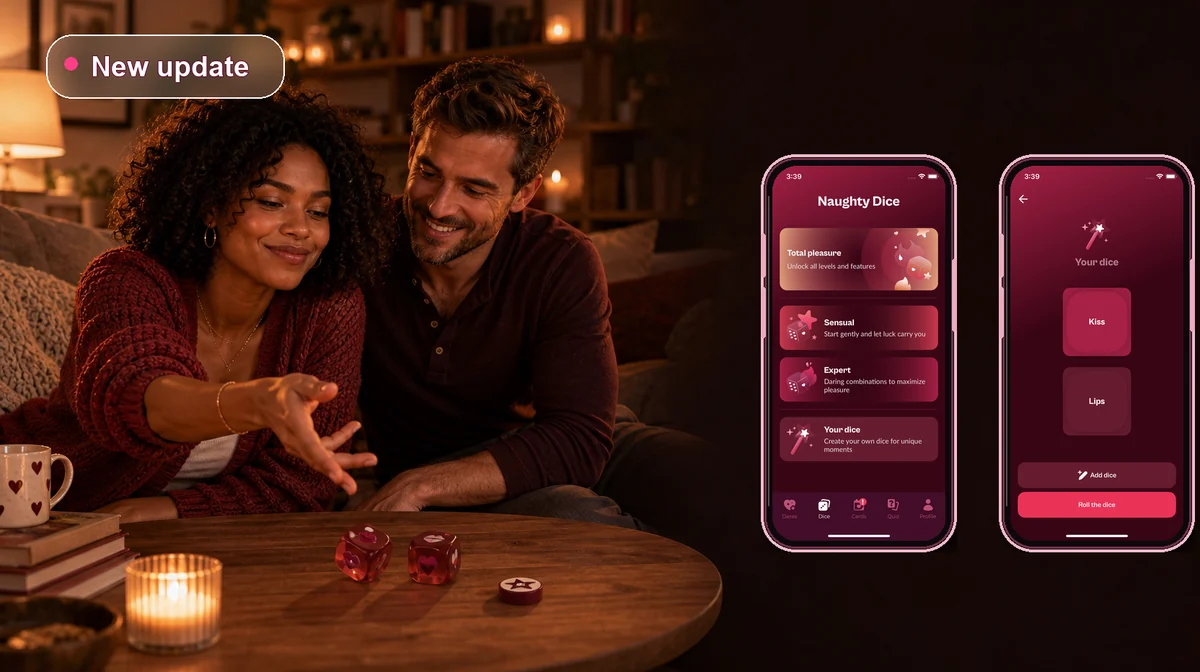
Learn how to play the Naughty Dice game, explore its levels and create your own action and body-part dice for a personalized couples game.

Let’s be real—having great sex isn’t just about technique; it’s about connection, communication, and a little creativity. If you’re looking to spice things up or just feel closer […]